
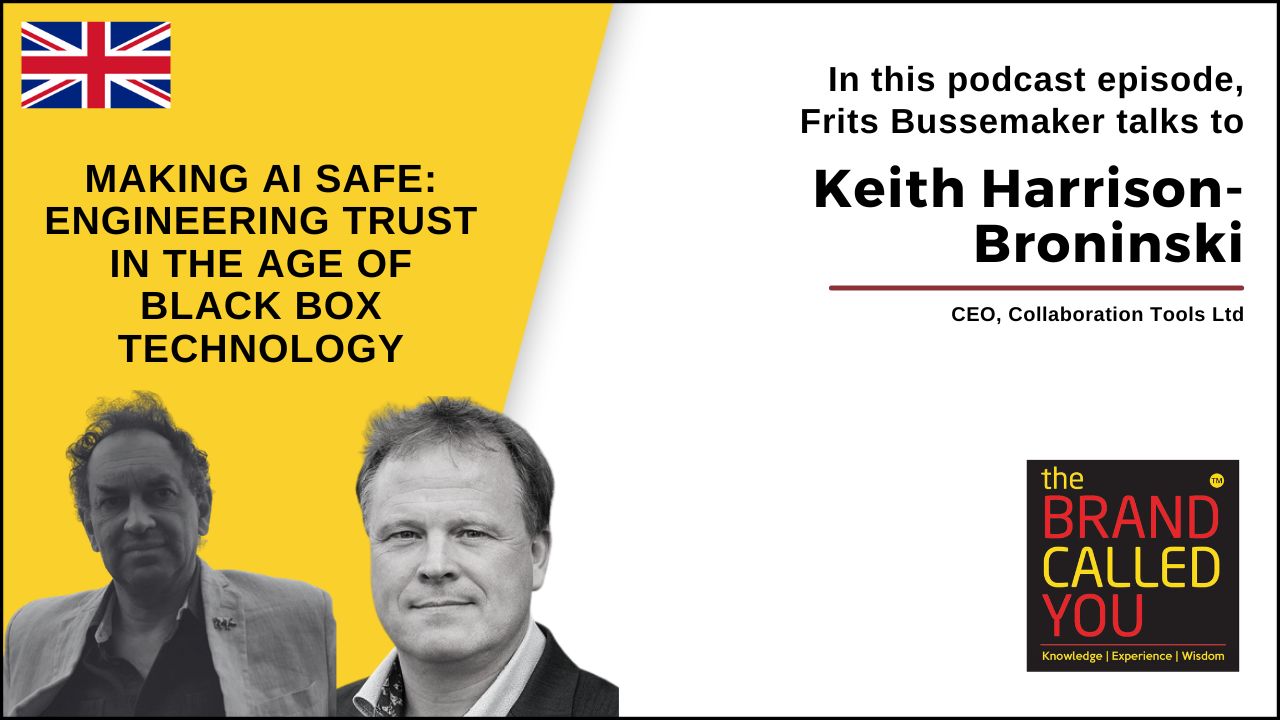
Last week I had the pleasure of speaking again with an old friend and colleague, Frits Bussemaker, for The Brand Called You. We discussed something I have long been passionate about, and that is now central to our work at Dedoctive.
For decades, my research has focused on helping people work together better across boundaries, particularly in communities. Over time, that has led me to question how to make safe, trustworthy, and accountable use of complex technology (now of course including, and in particular, AI) in decisions that affect people’s lives, infrastructure, and institutions in the real world.
One of the themes Frits and I explore is that there is a big difference between talking about responsible AI in general terms and actually doing the hard work of making AI safe in practice. In safety engineering, safety is not a vague aspiration. It means reducing risk to a level that is As Low As Reasonably Practicable (ALARP). That requires explicit reasoning, evidence, risk assessment, and documented justification. In other words, it requires engineering discipline.
Unfortunately, simply having a human in the loop does not address this challenge – if anything, it can blur responsibility rather than clarifying it. Calling AI human-centric can make it sound as though accountability has been handled, when in fact the underlying risks may still be poorly understood. If AI is influencing decisions, then the humans involved still need to be able to explain the assumptions being made, the hazards involved, the mitigations in place, and the residual risks that remain.
Frits and I discuss why AI in particular is difficult in comparison with other technologies. Because AI systems learn, they are not just complicated and opaque; they are adaptive, capable of producing an almost unlimited range of outputs in response to an almost unlimited range of inputs. That makes them unusually hard to reason about and unusually easy to misuse. Over the last decade, a lot of good work has been done in standards, frameworks, and regulation, from bodies such as ISO, NIST, and the EU. However, this in itself does not provide organisations with a practical way to fill the gap between governance and operational implementation.
The extreme difficulty of filling this gap means that efforts by organisations to comply with new regulations such as the EU AI Act and standards such as the NIST AI Risk Management Framework often deliver low value. They may even deliver harm, by giving people the impression that AI-enabled systems are compliant and safe, when in fact the risks and impacts of failures are poorly understood.
In the interview, I talk about how techniques drawn from systems engineering (e.g., safety cases, bowtie diagrams, and iterative audits) can help organisations move from broad policy ambitions to practical operational assurance. These techniques is that they force important things into the open: claims, arguments, evidence, weaknesses, controls, and conditions of use. They make the logic visible, risks discussable, and accountability harder to avoid. Importantly, the techniques are not rocket science, especially now that tools are becoming available that allow their use by people outside the rarefied world of safety.
For us at Dedoctive, trustworthy AI is not about pretending uncertainty has disappeared. It is about making uncertainty explicit and manageable by providing transparency, provenance, and context for every detail of an AI response. It is about helping human beings make better, more defensible decisions.
It’s also worth noting that, when safety becomes a primary design concern from the start, the result is not just lower risk. It is better systems that require less rework, resulting in more effective innovation with less cost and in less time. Safety is not a constraint. It is a way of seeing more clearly.
I’m grateful to Frits for such a thoughtful conversation and for the opportunity to discuss these ideas in depth.
- Watch the video interview.
- Read the white paper that underpins the discussion for the full argument and worked examples.
- Find out more about Safety Navigator.
Author
Keith Harrison-Broninski is an author, researcher, and keynote speaker specialising in cross-boundary collaboration, community antifragility, and technology for good. Keith’s awards include from Gartner for social enterprise and from the NHS for technology to replicate healthcare innovations.
Keith’s first book “Human Interactions” (2005) was described by Information Age as “the overarching framework for 21st century business technology”. Keith’s other books include two for Springer and three for the Workflow Management coalition. Keith’s most recent book “Supercommunities” (2021) was described by the Chief Executive of the RSA in his foreword as “Ranging from ancient history to economics to psychology to public policy ‘Supercommunities’ is both authoritative and highly readable. It puts our current challenges in context, shows why change is necessary and provides a trove of practical ideas for change makers.”
Vint Cerf, co-inventor of the Internet, in a second foreword, wrote “Supercommunities offers a path away from social and economic meltdown … We will need to replace short-term thinking with long term planning and execution if we are to regain upward motion towards common benefit for everyone on Spaceship Earth. To begin, read this book!”
Keith currently focuses on creating the Internet of Communities via his company’s revolutionary technology “Dedoctive” – a fundamental AI innovation, academically-validated for the MoD as fully trustworthy, that empowers reliable access to complex information for all.
Keith is also a jazz pianist, traditional folk musician, and classical composer. He has released 9 albums and performs regularly with a wide range of other musicians.
More information
Email Keith Harrison-Broninski: khb@dedoctive.ai
Leave a Reply
You must be logged in to post a comment.