
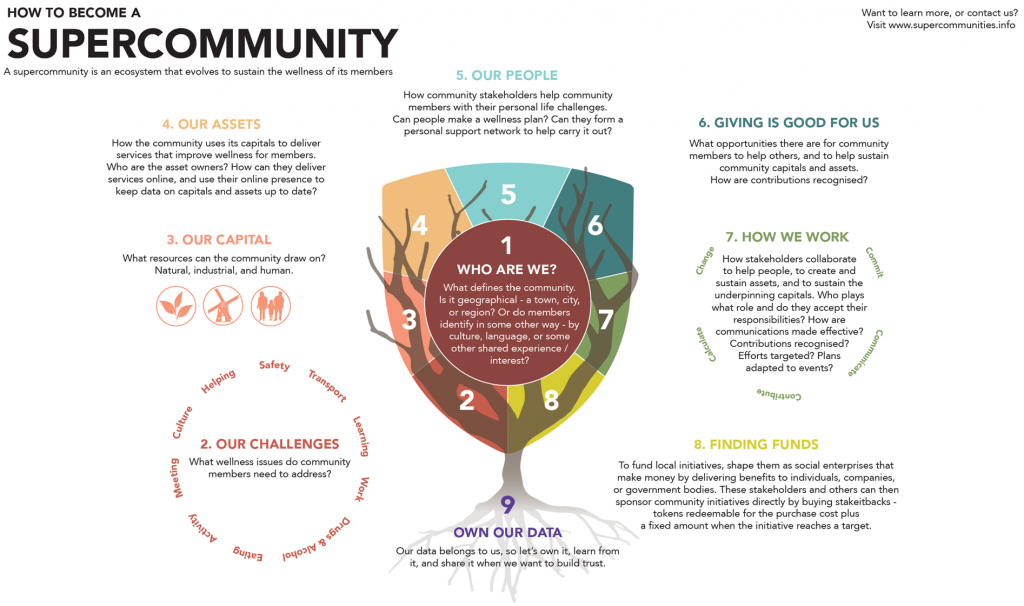
It is now commonly accepted that the likelihood of AI causing human extinction is significantly greater than zero. While technologists scramble to mitigate this threat by improving AI itself (which, some might argue, brings us ever closer to the brink), the world appears to have lost sight of how we could apply well-proven systems engineering tools to the challenge – and the secret sauce to safe AI is Supercommunities.
To see how this works, we need to step back from AI and look at the larger challenge facing global society. There is plenty of money washing around the global economy, but unfortunately not enough of it is where it needs to be – in the hands of governments.
The situation
Governments face increasing pressure to fund the services and investments expected by citizens. High debts and rising borrowing costs constrain budgets, while conflict, climate change, and demographic ageing create growing demands. Incremental changes to existing economic arrangements cannot solve this. New ways of generating economic value are required.
The complication
AI promises productivity gains but deepens the fiscal challenge. Its infrastructure consumes capital and energy. Benefits and investment are concentrated in private hands. New forms of automation reduce demand for labour, weaken existing service businesses, and increase welfare needs. AI stocks are over-priced so sector growth will not compensate.
Further, simply requiring a “human in the loop” will not address the automation challenge. In typical AI deployment, evidence behind an AI-generated recommendation is scattered across sources, the resulting answers sound convincing without being verifiable, and individuals asked to approve outputs lack the information needed to take meaningful responsibility.
For AI to become a true enabler of economic growth, we must step back from technology and ask what we aim to achieve using it. The strategic question is not what AI can automate, but what lasting public value it should help create.
The resolution
A starting point is to ask how communities can become more capable of sustaining their own members’ wellness. Communities are not only geographical – they can also form around occupations, interests, shared challenges, or other forms of mutual dependence.
The Supercommunities proposition is that community stakeholders can transform local capitals into practical assets that improve wellbeing and build the capacity to respond to new problems via repeated learning and adaptation. Communities can reduce their dependency on state intervention and become antifragile: able to use each external challenge to grow stronger.
The proposition was first set out in “Supercommunities” (2021) then adopted and proven by the UK Ministry of Defence. The forthcoming 2nd edition extends the concept across 3 further levels:
- Superorganisations achieve enduring success by moving beyond growth as an end in itself and becoming platforms that help their communities flourish.
- Supernations fuse aggregated statistics with attention to signals from their communities, reducing uncertainty and enabling earlier, more targeted responses to hazards.
- Supertechnology helps communities gain ownership over their own data and use it to make meaningful decisions that improve local outcomes.
These levels are connected by the Internet of Communities – a new framework for data usage within and across communities. Communities can use its apps to understand their own challenges, share relevant knowledge on terms they control, identify opportunities for collaboration, and adapt their assets as circumstances change.
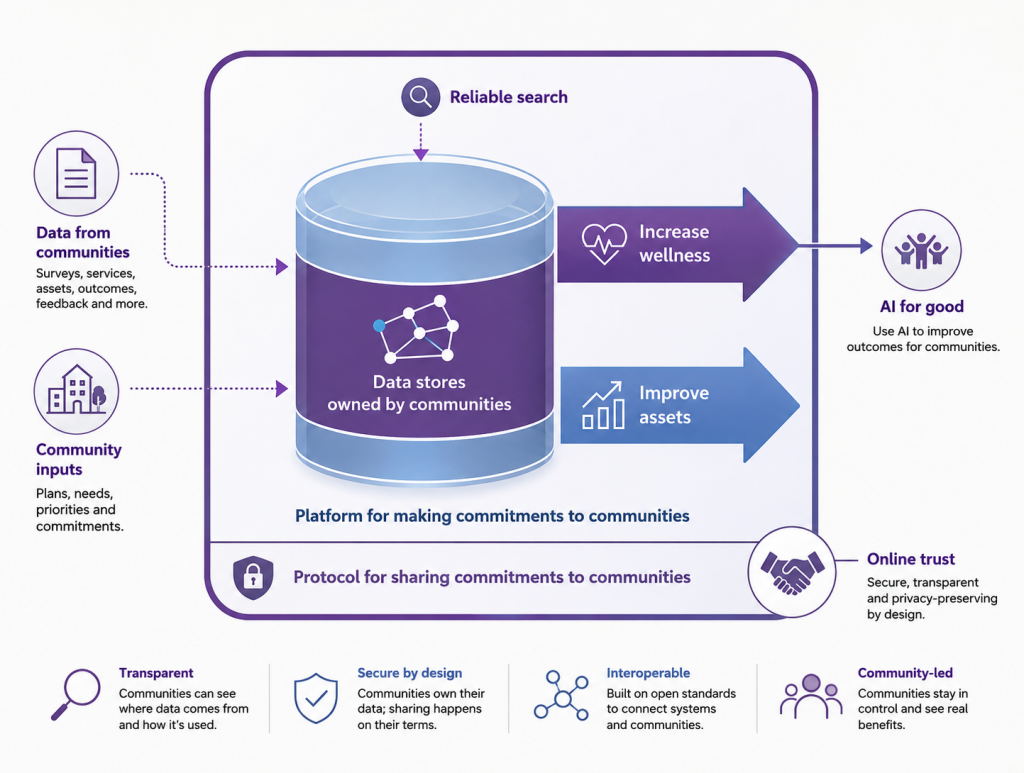
Established safety-engineering approaches, including safety cases, bowtie diagrams, and iterative assurance audits, help communities trust AI-enabled decisions by making explicit the underpinning assumptions, evidence, limits, weaknesses, risks, mitigations, and legality. A community is the boundary necessary to create an AI-enabled system in which safety can be forensically determined.
If we want safe AI (and we do), we need Supercommunities.
Author
Keith Harrison-Broninski is an author, researcher, and keynote speaker specialising in cross-boundary collaboration, community antifragility, and technology for good. Keith’s awards include from Gartner for social enterprise and from the NHS for technology to replicate healthcare innovations.
Keith’s first book “Human Interactions” (2005) was described by Information Age as “the overarching framework for 21st century business technology”. Keith’s other books include two for Springer and three for the Workflow Management coalition. Keith’s most recent book “Supercommunities” (2021) was described by the Chief Executive of the RSA in his foreword as “Ranging from ancient history to economics to psychology to public policy ‘Supercommunities’ is both authoritative and highly readable. It puts our current challenges in context, shows why change is necessary and provides a trove of practical ideas for change makers.”
Vint Cerf, co-inventor of the Internet, in a second foreword, wrote “Supercommunities offers a path away from social and economic meltdown … We will need to replace short-term thinking with long term planning and execution if we are to regain upward motion towards common benefit for everyone on Spaceship Earth. To begin, read this book!”
Keith currently focuses on creating the Internet of Communities via his company’s revolutionary technology “Dedoctive” – a fundamental AI innovation, academically-validated for the MoD as fully trustworthy, that empowers reliable access to complex information for all.
Keith is also a jazz pianist, traditional folk musician, and classical composer. He has released 9 albums and performs regularly with a wide range of other musicians.
More information
Email Keith Harrison-Broninski: khb@dedoctive.ai
Leave a Reply
You must be logged in to post a comment.